It's Not How Much You Pay. It's What You're Financing.
30 days in Brazil. 30 days in Brazil all-inclusive with my girlfriend.
That's what I could have afforded with the last amount of money I paid in taxes.
So one starts to wonder: but how much are they actually taxing us? And for a developer, does it make sense to go from being an employee to freelance/self-employed ? is it safer to stay as an employee?
By the end of this article, you'll have all the tools you need to decide which path is right for you and achieve your definition of success.
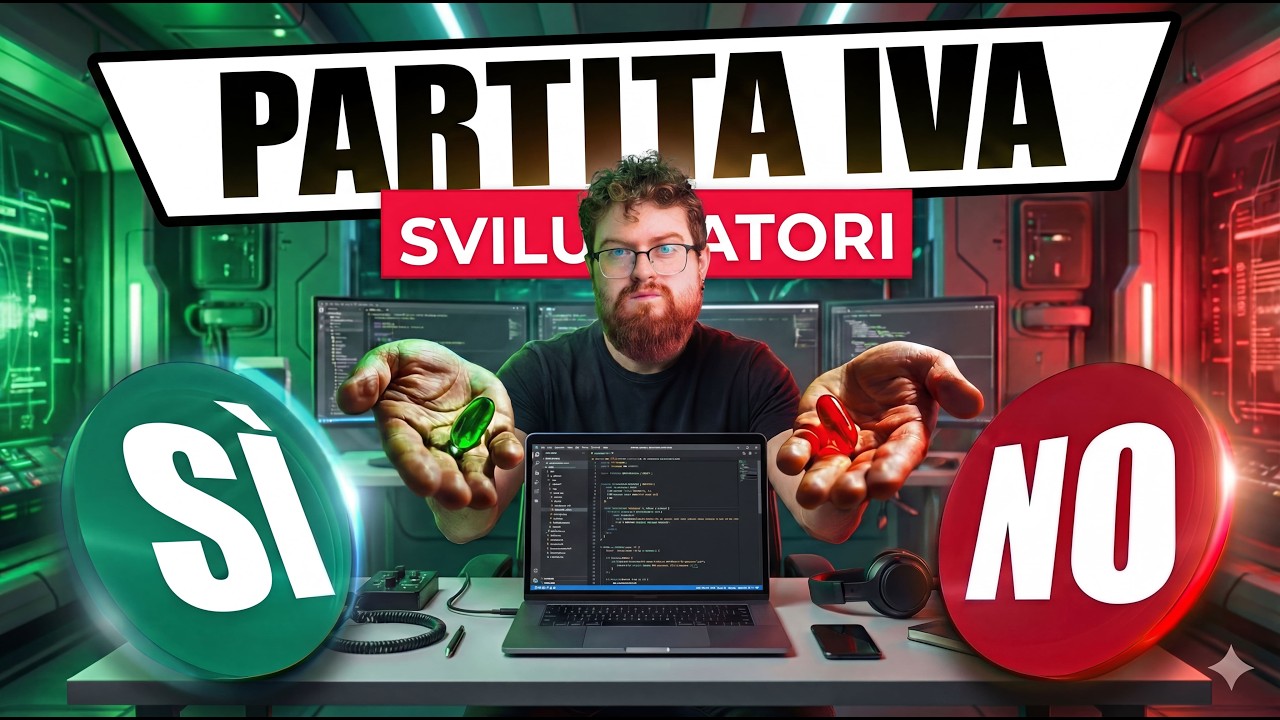
Watch the Full Video
I explained everything in a video where I show you exactly how the calculations work, with real examples and concrete numbers.
Who I Am and Why You Should Listen
Hi, I'm Davide Mastricci and I'm a former employee turned freelancer for 4 years now. I develop applications for clients and also build my own projects to create additional income streams.
If you're interested in understanding how to build something of your own without constantly stressing about working on your personal projects alongside your employee job, and especially if you want to create freedom and not career labels, you're in the right place.
What We'll Cover in This Article
In this article we'll explore three things:
- Tax calculation - How it works, what it means for a developer to be self-employed and what opportunities open up
- The difference between employee and freelancer - We'll examine false beliefs and myths of each
- How to decide what to do - Tools to make a conscious choice, not play a game that's assigned to you
Part 1: Tax Calculation
Before doing the calculation, there are some key concepts to understand.
Understand Your Activity Code
Your activity code is what the tax system uses to identify your business type. It's essentially a number with a description of what you can do.
As a developer, you might be classified as a software developer/consultant, depending on your jurisdiction.
The important thing is understanding that different activities have different tax benefits.
The Flat-Rate Tax Regime
The flat-rate regime is a system where your costs are determined forfeitarily by the government instead of being calculated based on your actual expenses.
In a regular regime, if you earn €10,000, that's considered your actual income. But in reality, you have costs: Cloud services, ChatGPT, software tools, etc. You need to track these and deduct them to find your actual profit to calculate taxes on.
In the flat-rate regime, this doesn't exist.
A government coefficient of profitability is introduced: some legislator did a big study and said "You software developer, on what you earn, I know that approximately 33% you spend on equipment, ChatGPT, tools, etc. So your real profit is 67%."
Important: You'll pay taxes on 67% of what you earn.
If you earn €10,000, you pay taxes on €6,700.
How Taxes Are Calculated
Taxes are calculated considering:
- Income Tax - Tax on your income
- Social Security - Retirement contributions
Income Tax: Typically 5-15% on this 67%.
- 5% if you meet startup requirements (first 5 years)
- 15% after 5 years
Social Security: Calculated on the 67%, and is around 27% depending on your jurisdiction.
So: take your total, calculate 67%, apply 5% (or 15%) for income tax and 27% for social security. These are the taxes you pay to the government.
The Tool for Calculating
Use tools like calcolopartitaiva.it which is very useful because it's updated annually.
Practical example with €40,000 in revenue:
- Regime: Flat-rate
- Annual revenue: €40,000 (what you expect to earn from clients)
- Sector: Software development
- Social security: ~27%
- Startup: Yes (first 5 years)
Result:
- Net annual: €32,000 (80% of total earnings)
- Net monthly: €2,670
- Income Tax: ~€1,000/year (2.5% of total)
- Social Security: ~€7,000/year (17.4% of total)
80% of your earnings are yours, 20% goes to the government.
If you're not in your first 5 years (Income Tax at 15%):
- Net annual: €30,000 (75% of earnings)
- Net monthly: €2,500
- Difference: ~€200/month less
You obviously don't get benefits like pension, health insurance, paid vacation, sick leave, or anything. But in the next section I'll show you how this is actually a false problem.
Calculation for Employees
Using standard tax calculators for your country.
Example with €40,000 gross salary:
- Gross salary: €40,000
- Region: Varies by location
- Pay periods: Typically 12 months
Result:
- Net annual: ~€28,178 (70% of gross)
- Net monthly: ~€2,350
Comparison:
- Freelancer (startup): €2,670/month
- Employee: €2,350/month
- Difference: +€320/month as a freelancer
Why This Difference?
Income Tax: As a freelancer you pay a flat 5% (or 15%) in the flat-rate regime. As an employee you pay on brackets - the higher your salary, the more you pay.
In the flat-rate regime, up to €85,000 per year, you pay maximum 15% (or 5% in the first 5 years).
Social Security: As a freelancer you pay ~€7,000/year. As an employee you pay ~€3,000/year, because social security is split between you and your employer (who contributes the other half).
Bottom line: About €300 more per month as a freelancer, with established vacations (20 days), paid sick leave, and other perks.
The Mental Difference (Very Important)
As an employee, €2,350 arrives in your bank account every month.
As a freelancer, €40,000 ÷ 12 = €3,333/month arrives.
From this you must subtract the €2,670 that you can actually spend, leaving €663 remaining.
These funds will sit in your bank account and it's your responsibility to set them aside, because eventually your accountant will come and say: "We need to pay income tax and social security, take those €600 you've saved every month and give them to me."
As an employee, the same thing happens, except instead of your accountant calling you, they call your employer, who acts as your tax withholding agent (pays for you).
How much time do I spend on this?
I do it twice a year, an hour each time. 2 hours per year. And I partially delegate, but you can fully delegate to an accountant: they see everything, only call you for money and your bank account. That's it.
Part 2: The Opportunities That Open Up
Now let's talk about the opportunities that a freelancer versus an employee has.
This is very important that you follow, because I want you to make a conscious choice about your career and your life, not simply play a game that was assigned to you that you never chose.
From Your Home Country to Europe (and the World)
With freelance status, you can now work across Europe, and worldwide.
Many companies without legal headquarters in your country can now hire you (or become your clients) because they now have the ability to do it.
If you didn't have freelance status, they couldn't.
On LinkedIn, in the Jobs section, instead of setting your location to just your country, you can set it to "EMEA" (Europe, Middle East, Africa - a much larger region with manageable timezones where you won't need to work nights).
But Why Work in Europe?
Let's look at numbers from Levels.fyi:
These are data points that help us see the trend, not exact numbers.
🇮🇹 Italy
- Median: €36,000
- 25th percentile (lower earners): €29,000
- Average: €46,000
- 75th percentile (higher earners): €61,000+
🇩🇪 Germany
- Median: €80,000
- 25th percentile (lower earners): €66,000
Wait.
€61,000 in Italy is what high earners make. €66,000 in Germany is what low earners make.
See why a German entrepreneur would want to hire an Italian freelancer? They pay you what a "junior" makes, but they get a senior Italian developer.
Other Countries
🇩🇰 Denmark: Median €75,000 🇪🇸 Spain: Median €49,000 (vs €36,000 in Italy) 🇵🇹 Portugal: Median €45,000 🇬🇷 Greece: Similar to Italy (but I've had Greek clients anyway)
Almost everyone benefits from hiring an Italian freelancer.
The Poland Case (B2B Contracts)
I've received lots of B2B hiring requests from Poland.
When they hire this way, they don't consider vacation, sick leave, severance, nothing. They don't care. You're a company they give a contract to and you need to deliver it within agreed terms.
Perform poorly? Tough luck.
And here we enter the next point...
Part 3: The False Beliefs (Very Important)
This is not a pro-freelance argument. I'm telling you again: by the end of this article you'll have the tools to choose the right path for you.
But you must be aware of who you're enriching and why you're giving certain money to someone rather than to yourself.
1. Vacations and Sick Leave
How do you handle them?
The same way any system handles them: you factor them into your rate.
If I wanted €40,000 as an employee in my country, sick leave and vacation are already included in that number.
As a freelancer you decide:
- How many vacation days do you want? 20 days? A month?
- Do the math (you can use ChatGPT): "I want to take 20 days of vacation. How much do I need to charge to bring home €40,000?"
Sick leave works the same way. Average estimates exist for how many days you might take.
You do a simulation based on your history, add that amount like you did with vacation, and you have your rate, your non-negotiable package, your minimum.
But you have an idea of what you need to survive.
So this is a false belief: you can always do this math and, based on the numbers we've seen, ask for more.
The key is demonstrating the capability: you need the skills to ask for that amount, and you need to prove you're good.
2. Stability
Freelance: It's always said that everything is very unstable, you never know your earnings.
Yes, but no. It depends on the type of clients you find.
As I explained, you can get long-term contracts (or permanent freelance positions) and those contracts give you an annual income that you know exactly month by month. I call that stability.
"Yeah, but as a freelancer you can be fired anytime."
True. But:
- It's written in the contract what rules apply
- Medium-large companies care about their reputation (nobody wants to work with them if they look bad)
- Let's be honest: even if in 2026 "vibe coding" is big, our jobs are very much in demand, especially if you specialize in artificial intelligence
Employee: Your salary is guaranteed? Yes. But if they want to fire you, they fire you.
Big companies, if they lack economic capacity, find ways to make you leave: mobbing, terrible projects...
Everyone knows the capabilities and methods a company has to make you want to leave.
This too is a false myth.
3. Tax Risk
Freelance: "The tax authorities will audit me, there's this sword of Damocles."
Yes, there is. But there is as an employee too - it depends on how honest your tax return is.
Many things we do are pretty straightforward to report. There's not much to hide or avoid declaring, because taxation is much more favorable than for employees.
Getting in trouble is almost silly.
Employee: "Zero risk, someone else handles it."
True, but that someone else can make mistakes too. And if they do... honestly I'm not sure what happens. Do you know?
4. Career
Freelance: "You're alone, how much can you really grow? You don't have a team."
The fact that you're alone is not a limitation. It depends a lot on projects and personality.
As a freelancer with the "threat" of being let go (which, remember, is mental, not real - it depends on your contract), I'm pushed to learn more.
But the main way I do this is because I'm interested in learning more.
If you're interested you do it, if you're not you don't. Let's be honest.
Employee: "There's a team, you grow together."
There's something different: your growth is linear and determined by company standards. You adapt.
In performance reviews, you might have done great all year, but they'll tell you "You didn't exceed expectations, you just did what you were supposed to. You don't deserve a promotion."
What growth are we talking about?
As a freelancer you have a pool of European companies. As an employee you have those in your country (which are many, but not like the European pool).
5. Negotiation Power
Freelance: You have much stronger negotiation power because, given all the calculations, you shape the situation to you.
"I need X amount because I want X vacation days. I need Y amount to guarantee Z days of sick leave."
As long as you find the client (very common) who hires you as a freelancer but treats you like an employee (you get benefits but also downsides - all pre-negotiated).
In the Poland case, you add everything and manage it yourself. You have significant negotiation power.
Employee: It's very much "boss commands" (the company or the corporate structure).
"You have 20 days of vacation, you can ask for more but it needs to be contractualized."
If the company is big: "But who do you think you are?"
As a freelancer you are their partner, more than their employee. Even the communication level is different.
6. Retirement
Let's start with the understanding that in both cases I think your pension will be very, very low.
And anyway it doesn't make sense to talk about pensions because in both cases we pay social security.
Social security contributions fund current pensions, not yours in the future.
Based on how many years of contributions you'll have when it's your turn, and based on what the government can afford, they'll decide how much to give you.
That's the reality.
There's no guaranteed pension. It's a political move.
In both cases these are false beliefs ("in one you don't have it, in the other you do").
My suggestion: create it yourself.
Severance (TFR)
Severance is not something given to you for free.
It's simply taken from your monthly pay and set aside by your employer. You can only decide whether to put it in a pension fund or leave it with the company.
With freelance status, since those are earnings you make, you decide what to do.
You can spend it, invest it, keep it - it's up to you.
Real Example on LinkedIn
If you go to LinkedIn → Jobs section:
- Location: EMEA or Europe
- Remote: Full remote
- Job type: Contract
Filter and boom: tons of opportunities.
Example I found:
- Technical Lead for Industry 4.0 (freelancer, long-term contract)
- Lots from Poland (as I mentioned)
- UK companies - they pay much more
- Tons of stuff
That world opens up for you.
Your Choice
Now it's up to you. What will you do with all this information?
Now you're aware of:
- ✅ What the risks are of going freelance
- ✅ What the risks are of staying employed
- ✅ The benefits of being freelance
- ✅ The benefits of being employed
Often it's just a bit more peace of mind for those who are employed. But if you're freelance, often you don't have those problems.
Recap
In this article we understood:
- Tax calculations and how they work for freelancers
- What opportunities await once you become freelance (wider pool of possibilities)
- What are the false beliefs and myths of one vs the other
Now you know very well who you're enriching with the money you're earning and the taxes you're paying.
Useful Links
- Complete video on YouTube - Watch all the calculations in action
- Tax Calculator - Tool to calculate taxes
- Net Salary Calculator - To compare with employee status
- Levels.fyi - Developer salaries across Europe
Want to Become an AI Freelancer?
If you're seriously thinking about going freelance as a developer, I've prepared free resources for you:
📺 Subscribe to YouTube
On my channel you'll find practical videos on:
- AI and automation tutorials
- My 4 years of experience as a freelancer
- Anti-hustle culture and sustainable solopreneurship
→ Subscribe to my YouTube channel
📧 Subscribe to the Newsletter
Every week I send:
- Practical strategies for AI freelancers
- Case studies of my projects
- Work opportunities in Europe
- Tools and resources to automate your business
→ Subscribe to the newsletter (Link coming soon)
Have questions? Write to me on LinkedIn or leave a comment on the YouTube video. I always respond.